Brazil became a top-5 betting market. So I built a Brazil style into Aduarius.
Brazil's regulated betting market hit ~US$7B in its first year. Here's why I built a dedicated Brazil visual style into Aduarius – reading a market as product.
In its first regulated year, Brazil's online betting market produced R$37 billion – around US$7 billion – in gross gaming revenue. In the same year it ranked as the fifth-largest betting market on earth, behind only the US, UK, Italy and Russia. Twenty-five million Brazilians placed a bet on a licensed platform. Eighteen months earlier, in legal terms, that market barely existed.
When a market moves like that, generic ad creative stops being good enough. That gap is exactly what I built for: this year I added a dedicated Brazil style to Aduarius, the AI tool I run that turns a brief into on-brand ad creative in seconds. This is the thinking behind that call – the market read, the design decisions, and why a market-specific style is a product decision, not a decoration.
Why Brazil, and why now
Brazil legalised fixed-odds betting on paper back in 2018, but for years it ran as a grey market. Law 14.790, sanctioned at the end of 2023, turned it into a licensed regime, and the regulated market went live on 1 January 2025. Licensed operators run only on .bet.br domains. Deposits move through Pix – Brazil's instant-payment rail – and a 2024 finance-ministry rule bans credit cards and every other post-paid instrument outright, so money is mobile-first and immediate by regulation. In August 2024 alone, the central bank put bet-related Pix transfers at R$20.8 billion. Dozens of licensed operators went live at once, all chasing the same players, all needing creative in volume.
I've shipped into this market before. Leading product design at GoBet, I helped take the platform into Brazil alongside Chile and Peru – a localisation push that tracked with a 110% jump in daily active users. So when I say a Brazilian player doesn't respond to the same banner as a European one, it isn't a hunch. It's the difference between creative that belongs and creative that was clearly made somewhere else.
A market this specific needs a look this specific
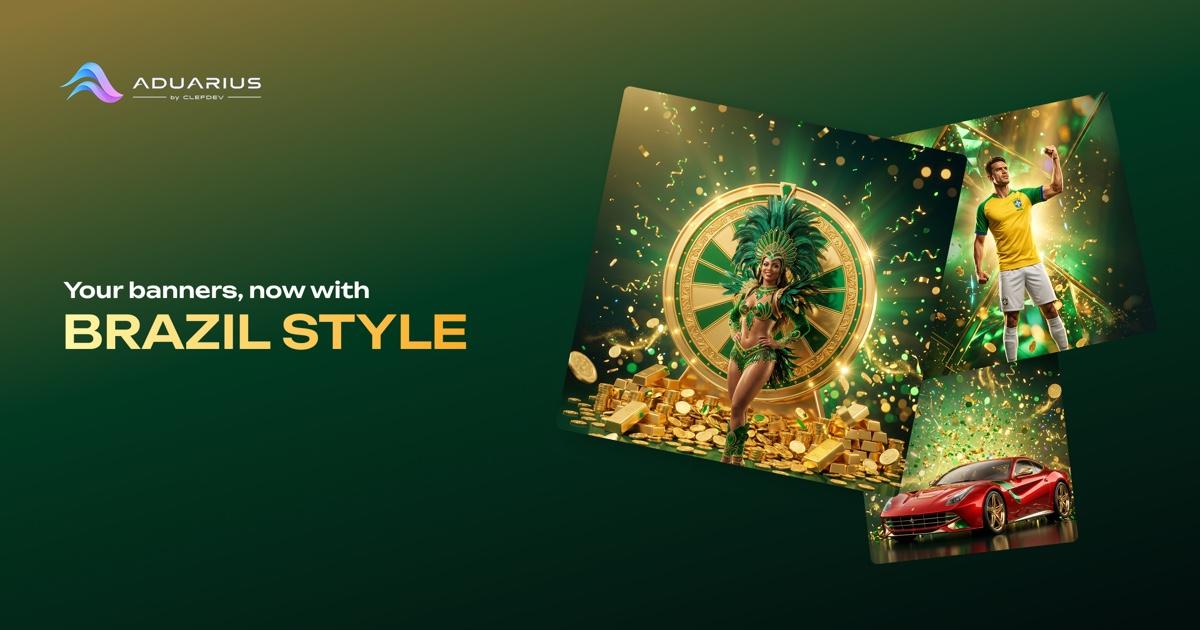
Brazil has one of the most legible visual identities of any market. Verde-e-ouro – the green and gold of the flag – reads as national pride before a single word is processed. Football isn't a vertical here, it's the culture. Carnival energy, gold coins, the lucky-win moment, the R$ and Pix cues people transact with every day – these are signals a Brazilian audience recognises instantly.
A European template with the colours swapped carries none of that, and a generic AI image carries even less. It produces something that looks approximately like a banner and nothing like Brazil. In a market where dozens of operators are fighting for the same deposit, looking like you belong is not a finishing touch. It's the whole first impression.
Designing the style as a system, not a filter
A style, done right, is a system of decisions, not a colour swap. Brazil's is built on a high-energy verde-e-ouro palette, football and carnival motifs, and the lucky-win, gold-coin language that performance creative in this market leans on.
I drew the lines deliberately against the styles sitting next to it. A crypto style runs on cold, neon tech-green; an Asian fortune style on red and gold. Brazil had to read as unmistakably itself, not a cousin of either – so its green is warm and national, not technological. There are composition rules baked in too: hero figures are anchored to the bottom edge, for instance, so you never get the floating, cropped-off legs that make AI creative look cheap. The point of all of it is that the user picks the style, writes the brief, and every output lands on-brand for Brazil by default – without a designer redrawing anything.
Reading a market is the actual product work
Wiring an image model into a product is the easy part now. The judgment is everything around it: seeing that Brazil had gone from grey market to top-five in a single year, deciding that warranted a first-class style rather than a preset nobody maintains, and then encoding what "Brazilian" actually means into something repeatable and on-brand every time.
That's three jobs in one decision – the founder choosing where to invest, the product manager scoping what ships, and the design lead building the system that holds it together. It's the way I've worked for a decade across iGaming, fintech and Web3, and the way my studio ClefDev builds market-specific presets on top of the engine.
The pattern, not just the market
Brazil is the clearest example right now, but the pattern is the point: the teams that win a market show up looking like they belong in it, and they do it at the speed the market moves. A booming, mobile-first, football-obsessed market rewards creative that feels native and punishes creative that doesn't.
If you run performance creative for iGaming – in Brazil or anywhere – Aduarius is live, with the Brazil style ready to use. And if you've got a market to enter and a product that needs to look like it belongs there, that's the work I do.
More on how I work: how I built Aduarius from zero, a mobile casino app I designed, and how I run an iGaming build.
Sources
- iGaming Business – First year of licensed Brazil online betting generates $7 billion in GGR (January 2026)
- Yogonet International – Brazil will close 2025 as the world's fifth-largest betting market (November 2025)
- Presidência da República (Planalto) – Lei nº 13.756, de 12 de dezembro de 2018 (December 2018)
- Presidência da República (Planalto) – Lei nº 14.790, de 29 de dezembro de 2023 (December 2023)
- iGaming Business – Legal Brazil betting market launches with 14 companies receiving full licences (January 2025)
- LegisWeb – Instrução Normativa MF/SPA nº 11 de 04/11/2024 (November 2024)
- NormasBrasil – Portaria Normativa SPA/MF nº 615 de 16/04/2024 (April 2024)
- Banco Central do Brasil – Análise técnica sobre o mercado de apostas online no Brasil e o perfil dos apostadores (September 2024)